Creatine benefits and side effects, from hair loss to memory
A 2025 trial found no hair loss from creatine, and a review of 16 trials found a small memory gain. What creatine does, and the blood test it can skew.
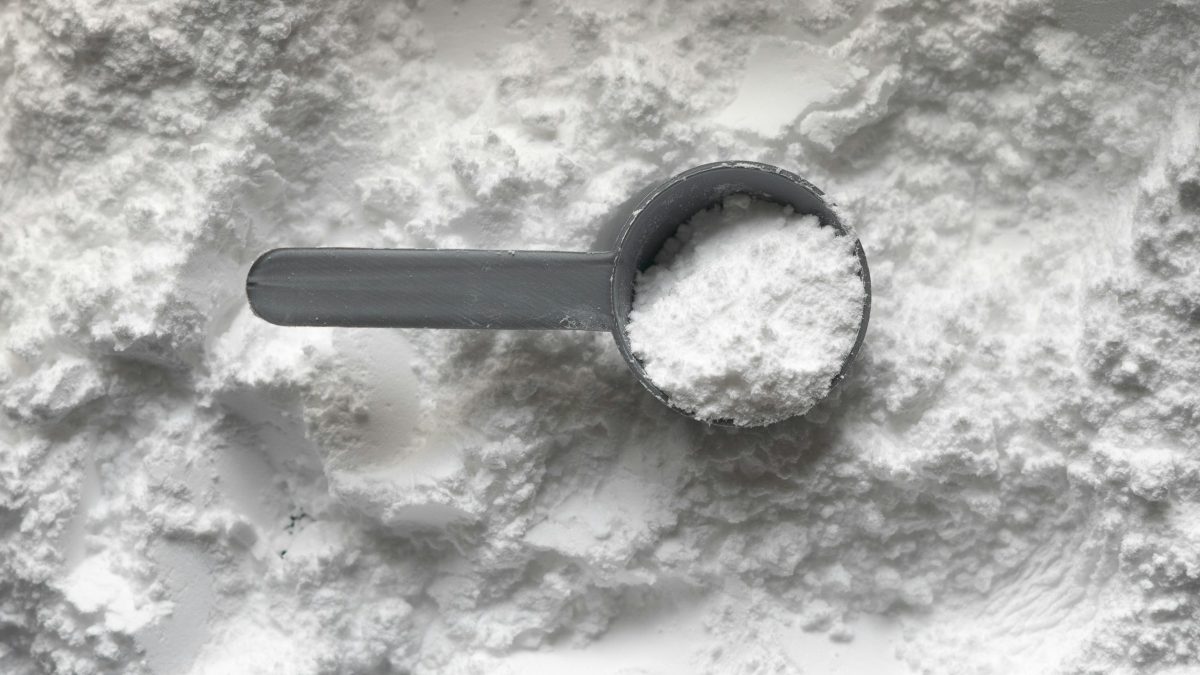
Creatine used to be a scoop in a bodybuilder’s shaker. Now it is sold to women, to older adults and to anyone who wants a sharper mind, and the questions people search for have changed with it. Will it make my hair fall out? Does it help the brain? Is it bad for the kidneys? Recent trials answer some of these well and others only in part.
What does creatine do?
Your body makes creatine and you also get it from meat.3 Muscles turn it into phosphocreatine, which they use to rebuild their energy during short, hard efforts such as lifting or sprinting.3 Taken alongside strength training, creatine adds to gains in strength and lean mass.1
Does creatine cause hair loss?
The fear goes back to one study. Male college rugby players who took creatine had a rise in DHT, a hormone that can shrink hair follicles in men prone to baldness.3 That study never looked at hair, and no study has reported hair loss in people taking creatine.3
In 2025, a team tested the question directly. They randomly gave 45 young men aged 18 to 40, all of whom lifted weights, either creatine or a placebo for 12 weeks, and 38 finished. Testosterone, DHT and the ratio between them did not differ between the groups, and neither did hair density, the number of follicle units or hair thickness, measured with a trichogram and digital scans.1 The authors call it “strong evidence against the claim that creatine contributes to hair loss.”1
It was a small trial of young men over three months. It says little about years of use, about women, or about men already losing their hair.
Does creatine help memory and the brain?
A little, for memory. A 2024 review pooled 16 randomised trials with 492 adults aged 21 to 76, some healthy and some with an illness, all taking creatine monohydrate.2
| What was measured | Result | How sure the review is |
|---|---|---|
| Memory | Better | Moderate |
| Attention | Better | Low |
| Speed of thinking | Faster | Low |
| Overall thinking | No change | Low |
| Planning and self-control | No change | Low |
The gains were larger in people with an illness, in adults aged 18 to 60, and in women.2 In a 2024 lab study in Germany, a single large dose given during a night without sleep improved test scores and speed of thinking, and changed the energy chemistry of the brain on scans.4
Europe’s food safety authority read the same kind of evidence that year for a proposed health claim and concluded that a cause and effect between creatine and better thinking has not been established.5 For now, memory has the best evidence behind it.
Is creatine good for women?
70 to 80%
less creatine stored in women’s own bodies than in men’s, according to a 2021 review of creatine in women.
Smith-Ryan and colleagues, Nutrients, 20216
Most creatine research was done on men, and the evidence in women is thinner.6 Before menopause, creatine appears to improve strength and exercise performance. After menopause, it may help muscle size and function, and with strength training it has shown favourable effects on bone.6

Is creatine bad for your kidneys?
Not in healthy people. A 2021 review of the evidence concluded that creatine at recommended amounts does not damage the kidneys or harm how they work in healthy people, and the case reports of harm involved existing kidney disease, other medicines or other supplements.3
What it can do is change a test. Creatinine, the waste product doctors use to estimate how well the kidneys filter, can rise in the blood and urine when you take creatine or eat a lot of meat, so a higher result may reflect the supplement rather than the kidneys.3 If you have kidney disease, ask your doctor before taking creatine.
Who pays for creatine research?
Much of it comes from scientists who also work with the industry, and the papers say so. Authors of the 2025 hair trial advise, or have received support from, creatine and supplement companies.1 Two authors of the 2021 review on women advise a company that makes creatine.6 That does not make the findings wrong. It is a reason to want independent trials too, the question that turned the evidence on collagen upside down.
Every trial in the memory review used creatine monohydrate.2
If you are thinking about creatine
- Check that the label says creatine monohydrate, the form the trials used
- Tell whoever orders your blood tests that you take it
- Ask your doctor first if you have kidney disease or take regular medicines
- Remember the strength gains in trials came with training
- Ask who funded the study a brand quotes
Sources
- Lak M, Forbes SC, Ashtary-Larky D, et al. Does creatine cause hair loss? A 12-week randomized controlled trial. Journal of the International Society of Sports Nutrition. 2025;22(sup1):2495229. pubmed.ncbi.nlm.nih.gov/40265319/Checked 16 November 2026Back to the text
- Xu C, Bi S, Zhang W, Luo L. The effects of creatine supplementation on cognitive function in adults: a systematic review and meta-analysis. Frontiers in Nutrition. 2024;11:1424972. pubmed.ncbi.nlm.nih.gov/39070254/Checked 16 November 2026Back to the text
- Antonio J, Candow DG, Forbes SC, et al. Common questions and misconceptions about creatine supplementation: what does the scientific evidence really show? Journal of the International Society of Sports Nutrition. 2021;18(1):13. pubmed.ncbi.nlm.nih.gov/33557850/Checked 16 November 2026Back to the text
- Gordji-Nejad A, Matusch A, Kleedörfer S, et al. Single dose creatine improves cognitive performance and induces changes in cerebral high energy phosphates during sleep deprivation. Scientific Reports. 2024;14(1):4937. pubmed.ncbi.nlm.nih.gov/38418482/Checked 16 November 2026Back to the text
- EFSA Panel on Nutrition, Novel Foods and Food Allergens (NDA). Creatine and improvement in cognitive function: evaluation of a health claim pursuant to article 13(5) of regulation (EC) No 1924/2006. EFSA Journal. 2024;22(11):e9100. pubmed.ncbi.nlm.nih.gov/39564533/Checked 16 November 2026Back to the text
- Smith-Ryan AE, Cabre HE, Eckerson JM, Candow DG. Creatine supplementation in women’s health: a lifespan perspective. Nutrients. 2021;13(3):877. pubmed.ncbi.nlm.nih.gov/33800439/Checked 16 November 2026Back to the text
Photos: HowToGym, Scott Webb, Navy Medicine / Unsplash
This article is general information, not medical advice. For a question about your own health, your doctor or pharmacist is the right person to ask.