Ashwagandha benefits and side effects: what the trials show
Ashwagandha lowered cortisol in trials, yet people didn’t feel less stressed. What it does for sleep and testosterone, its side effects and the liver warning.
Ashwagandha is sold as the herb that takes the edge off stress, and on a blood test it seems to deliver. In a 2025 review, cortisol, the hormone that rises with stress, fell in the trials that measured it, yet the people taking ashwagandha did not rate themselves as clearly less stressed than those on placebo.1 The sleep and hormone trials also find modest changes, while a short list of serious liver cases has led several European food safety agencies to advise against it.
What is ashwagandha, and what is it used for?
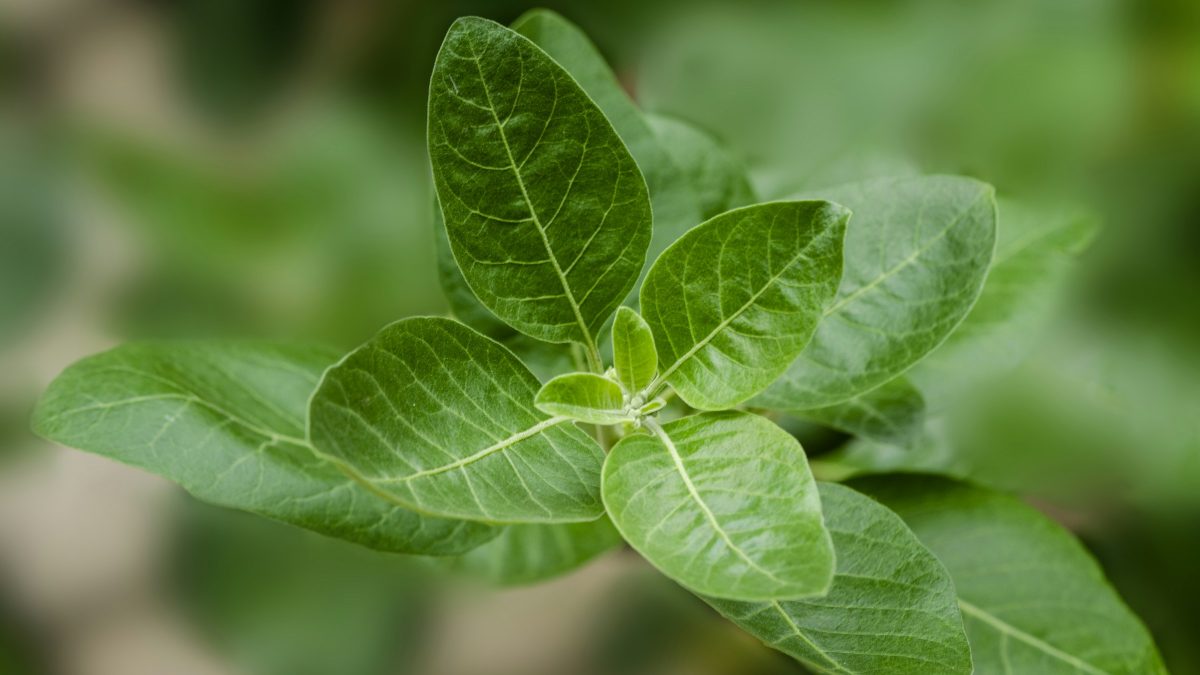
Ashwagandha (Withania somnifera), also called Indian ginseng or winter cherry, is a plant used in Ayurvedic medicine. Supplements are made mostly from its root, sometimes its leaves, and sold as powders, capsules, liquids and teas, with claims about stress, sleep and performance. Germany’s Federal Institute for Risk Assessment (BfR) says those benefits have not been scientifically proven.5
Its active compounds are thought to be withanolides and alkaloids, and how much of them a product holds varies widely with the part of the plant used and how it was extracted.5 In the EU, ashwagandha is sold as a food supplement, which needs no approval before it goes on sale; making sure it is safe is the seller’s job.5
Does ashwagandha lower stress and cortisol?
It lowers cortisol, but the people taking it do not clearly feel less stressed. A 2025 meta-analysis of randomised trials found that across seven of them, blood cortisol fell by 1.16 µg/dL more on ashwagandha than on placebo. Across the six that asked people to rate their own stress, the difference could have been chance.1
1.16 µg/dL
less cortisol in the blood on ashwagandha than on placebo, across seven trials. Across six trials, people’s own stress scores did not fall by more than chance.
Albalawi, Nutrition and Health, 20251
Its single author, at the University of Tabuk in Saudi Arabia, declared no conflicts of interest and calls for longer trials in a wider range of people to explain the gap.1
The trials behind these numbers are small. In one from 2019, 60 stressed but healthy adults at a hospital in Thane, India, took one of two amounts of a root extract or a placebo for eight weeks. On both amounts, stress scores and blood cortisol fell, and sleep quality improved compared with placebo.6 The extract was made and donated by its manufacturer, Ixoreal Biomed, and the authors declared no competing interests.6
Does ashwagandha help you sleep, and how long does it take?
It helped a little in trials, and more in the longer ones. A 2021 meta-analysis of five randomised trials with 400 adults found a small but significant improvement in overall sleep. The effect was clearer in people diagnosed with insomnia and in trials that lasted eight weeks or more.2
People on ashwagandha also woke more alert and were less anxious, though their quality of life did not change. No serious side effects were reported, but data on serious harms are limited, and the trials ran for six to 12 weeks, so longer use is barely studied.2
All five trials ran in India, and four tested the same branded root extract. One, testing a root and leaf extract, was partly sponsored by its manufacturer. The review itself, by family medicine researchers at Universiti Sains Malaysia, was unfunded, and its authors declared no competing interests.2

Many people also try magnesium at night, and here is what the newest magnesium trial found for sleep.
Does ashwagandha increase testosterone, and what does it do for women?
In men it raised testosterone in trials, and in women it did not. A 2026 meta-analysis of 23 randomised trials with 1,706 people found testosterone rose by 57.43 ng/dL more in men on ashwagandha than on placebo, against 5.09 ng/dL in women, a gap between the sexes that was statistically significant. Oestradiol did not change in either sex.3
The same review found that cortisol fell and serotonin rose. Its authors, in Poland and India, declared no conflicts of interest and call for more standardised trials.3
Many women also want to know about pregnancy. Ashwagandha has been used in traditional practice in China and India to induce abortion, and since nobody has studied that effect, the Dutch National Institute for Public Health and the Environment (RIVM) advises against it in pregnancy as a precaution.7 The BfR, citing too little safety data, advises pregnant and breastfeeding women and children in particular against it.5 If you are pregnant or breastfeeding, talk to your doctor or midwife before taking any herbal supplement.
Can ashwagandha affect your thyroid?
It can nudge thyroid hormone levels, and in at least one reported case it did much more. In the 2026 meta-analysis, thyroxine (T4) rose slightly, by 0.61 µg/dL, while TSH and T3 did not change.3 Among nine published case reports reviewed by RIVM, one described thyrotoxicosis, a state of too much thyroid hormone, in someone taking an ashwagandha supplement.7
The BfR raised concerns about its effect on thyroid function as early as 2012, and still lists thyroid hormones among the things it may affect.5 If you take thyroid medicine or your thyroid results are being followed, ask your doctor or pharmacist before you add ashwagandha, and mention it if you already take it. Here are the symptoms of an underactive thyroid, and what a normal TSH is.
Is ashwagandha bad for your liver?
For most people it seems not to be, but a small number have developed liver injury, and nobody can yet say who is at risk.7 A 2026 scoping review found 13 publications describing 25 people. The injury usually appeared after weeks of use, often with jaundice, meaning yellow skin or eyes, and itching.4
Most of the 25 recovered after stopping, usually over weeks to months. The serious outcomes were one case of acute liver failure that needed a transplant, and three deaths among people who already had cirrhosis.4 The authors, doctors in El Paso, Texas, received no funding for the work, and advise that people with advanced chronic liver disease avoid ashwagandha.4
The case reports involved amounts like those in supplements sold in the Netherlands, but trials at similar amounts saw no liver damage, so RIVM judged it unlikely that a large part of the population is at risk, though a sensitive person could still be harmed. The Dutch pharmacovigilance centre Lareb had received four reports of liver injury.7
If your skin or the whites of your eyes turn yellow, or you start itching all over, see a doctor promptly and tell them every supplement you take. If you have any liver condition, talk to your doctor before taking ashwagandha.
Is ashwagandha safe, and why is it restricted in some countries?
Food safety agencies in Denmark, Germany and the Netherlands have each reviewed it, and none could name an amount it considers safe. The Food Institute at the Technical University of Denmark concluded in 2020 that no intake of the root or its extracts could be called risk free, and in 2021 a Danish appeals board upheld a ban on selling two supplements containing it.8
Germany’s BfR could not derive a safe intake level either, and says that it and other European authorities advise against supplements containing ashwagandha.5 RIVM found that no safe level of use could be set and, as a precaution, advises consumers not to use it.7 In the UK, the Committee on Toxicity discussed a third draft statement on its safety in September 2026 and has not yet published its conclusions.9
| Country | Who reviewed it | What they concluded |
|---|---|---|
| Denmark | DTU Food Institute, 2020 | No intake limit could be set, and a ban on two products was upheld in 2021 |
| Germany | BfR, 2024 | No safe intake could be derived, and it advises against ashwagandha supplements |
| Netherlands | RIVM, 2024 | No safe level could be set, and it advises against use as a precaution |
| United Kingdom | Committee on Toxicity, 2026 | Still reviewing, with no conclusions published yet |
The BfR also warns that ashwagandha may interact with drugs that lower blood sugar or blood pressure, or that suppress the immune system.5 On blood sugar, a 2026 meta-analysis of 11 trials found fasting glucose fell by an average of 3.09 mg/dL, with very low certainty, and its HbA1c result was inconclusive. Its authors declared no competing interests.10 If you take any regular medicine, including thyroid tablets, sleeping pills or sedatives, ask your doctor or pharmacist before you try ashwagandha.
Before you try ashwagandha
- Check the label for the part of the plant used, root, leaves or both
- Know that the trials lasted 6 to 12 weeks, and longer use is barely studied
- If you are pregnant or breastfeeding, talk to your doctor first
- If you take medicine for your thyroid, blood sugar, blood pressure, sleep or immune system, ask a doctor or pharmacist first
- If you have a liver condition, tell your doctor before you take it
- See a doctor promptly if your skin or eyes turn yellow or you itch all over
- Note the day you started, so later blood tests can be read against it
Sources
- Albalawi AA. Dual impact of Ashwagandha: significant cortisol reduction but no effects on perceived stress. A systematic review and meta-analysis. Nutrition and Health. 2025;31(4):1395-1408. pubmed.ncbi.nlm.nih.gov/40746175/Checked 22 November 2026Back to the text
- Cheah KL, Norhayati MN, Husniati Yaacob L, Abdul Rahman R. Effect of Ashwagandha (Withania somnifera) extract on sleep: a systematic review and meta-analysis. PLoS One. 2021;16(9):e0257843. pubmed.ncbi.nlm.nih.gov/34559859/Checked 22 November 2026Back to the text
- Fornalik M, Malkiewicz A, Adamczak D, Nawrocki F, Zielinska A, Mondal SA. Hormonal modulation with Withania somnifera: systematic review and meta-analysis of randomized-controlled trials. Planta Medica. 2026;92(8):790-805. pubmed.ncbi.nlm.nih.gov/41740946/Checked 22 November 2026Back to the text
- McIntyre D, Nguyen P, Kim Y, Meyer B, Salloum M. Ashwagandha (Withania somnifera)-associated liver injury: a scoping review of clinical characteristics and safety considerations. Cureus. 2026;18(5):e109764. pubmed.ncbi.nlm.nih.gov/42367407/Checked 22 November 2026Back to the text
- German Federal Institute for Risk Assessment (BfR). Ashwagandha: food supplements with potential health risks. Communication 39/2024, 10 September 2024. bfr.bund.de/cm/349/ashwagandha-food-supplements-with-potential-health-risks.pdfChecked 22 November 2026Back to the text
- Salve J, Pate S, Debnath K, Langade D. Adaptogenic and anxiolytic effects of Ashwagandha root extract in healthy adults: a double-blind, randomized, placebo-controlled clinical study. Cureus. 2019;11(12):e6466. pubmed.ncbi.nlm.nih.gov/32021735/Checked 22 November 2026Back to the text
- de Heer JA. Risk assessment of herbal preparations containing Withania somnifera (Ashwagandha). RIVM letter report 2024-0029. National Institute for Public Health and the Environment (RIVM), 2024. rivm.nl/bibliotheek/rapporten/2024-0029.pdfChecked 22 November 2026Back to the text
- Danish Ministry of Food, Agriculture and Fisheries. Vejledning om kosttilskud (guidance on food supplements). VEJ nr 9488 of 28 June 2024, section on the Environment and Food Appeals Board decision of 1 July 2021 (case 21/05536), Withania somnifera. retsinformation.dk/eli/retsinfo/2024/9488Checked 22 November 2026Back to the text
- Committee on Toxicity of Chemicals in Food, Consumer Products and the Environment (COT). Draft minutes of the 8th September 2026 COT meeting, item 5. GOV.UK, updated 15 October 2026. gov.uk/government/publications/20th-october-2026-committee-on-toxicity-meeting/draft-minutes-of-the-8th-september-2026-cot-meetingChecked 22 November 2026Back to the text
- Farrin N, Nikparast A, Yadegari M, et al. The effects of Ashwagandha (Withania somnifera) supplementation on fasting blood glucose and HbA1c: a systematic review and dose-response meta-analysis of randomized controlled trials. Diabetes Research and Clinical Practice. 2026;241:113529. pubmed.ncbi.nlm.nih.gov/42641800/Checked 22 November 2026Back to the text
Photos: Bankim Desai, Emma-Jane Hobden, Jp Valery / Unsplash
This article is general information, not medical advice. For a question about your own health, your doctor or pharmacist is the right person to ask.