Blood pressure chart: why normal is the same at 30 and 70
Normal is under 120/80 at any adult age, yet 600 million people with high blood pressure don’t know it. The chart, the US and EU lines, and home readings.
Many people expect blood pressure to creep up with age, and look for a chart by age to see where they stand. The charts doctors use have no age column: the 2025 US guideline puts normal under 120/80 for every adult, and its goal of under 130/80 applies to younger and older patients alike.1
What is a normal blood pressure?
Under 120/80 mm Hg. The first number, systolic, is the pressure in your blood vessels when the heart beats, and the second, diastolic, is the pressure while it rests between beats.4 The 2025 US guideline sorts every adult reading into the same five groups.12
| Category (US, 2025) | Top number | Bottom number |
|---|---|---|
| Normal | Under 120 | and under 80 |
| Elevated | 120 to 129 | and under 80 |
| Stage 1 high blood pressure | 130 to 139 | or 80 to 89 |
| Stage 2 high blood pressure | 140 or more | or 90 or more |
| Severe | Over 180 | or over 120 |
The chart is the same at 30 and at 70. The guideline’s goal of under 130/80, with under 120 encouraged, applies to young and older patients, though its authors say doctors should use their judgment for each person, and research in older people supports 140 as a safe target.1
Is there a normal blood pressure by age?
Normal does not change with age, but the number of people above it does. In the US, 23.4% of adults aged 18 to 39 have high blood pressure, 52.5% of those aged 40 to 59 and 71.6% of those 60 and over, counting a reading of 130/80 or more, or taking medicine for it.5
A reading that is common at 65 can still be above normal. Of the American adults who have high blood pressure, 59.2% know it, and only about one in five has it below 130/80.5
Why do the US and Europe draw the line differently?
They agree on the risk and differ on the label. The US guideline calls 130/80 high blood pressure. The European Society of Cardiology’s 2024 guideline keeps that line at 140/90, as the WHO and the NHS do, and adds a new group, elevated blood pressure, for readings from 120/70 to 139/89.1346
“This new category of elevated blood pressure recognises that people do not go from normal BP to hypertensive overnight,” said Professor McEvoy, one of its authors.3 Another, Professor Touyz, added that the risks start at a top number even below 120. As many as 45% of European adults have high blood pressure.3
So a reading of 132/84 is high blood pressure in the US and elevated in Europe. Under either chart, it is a number worth watching.
What are the symptoms of high blood pressure?
Usually none. The NHS says high blood pressure does not usually cause symptoms, and only rarely headaches or blurred vision, so the only way to know is to have it checked.67
600 million
adults worldwide have high blood pressure without knowing it, 44% of everyone who has it.
World Health Organization, 20254
Very high blood pressure, usually 180/120 or more, can cause severe headaches, chest pain, dizziness, difficulty breathing, nausea, blurred vision and confusion. The WHO says to seek care at once if you have these symptoms and a high reading.4 Chest pain that does not go away, or pain spreading to your arm, neck, jaw or back, is a reason to call emergency services straight away.6
How to take your blood pressure at home
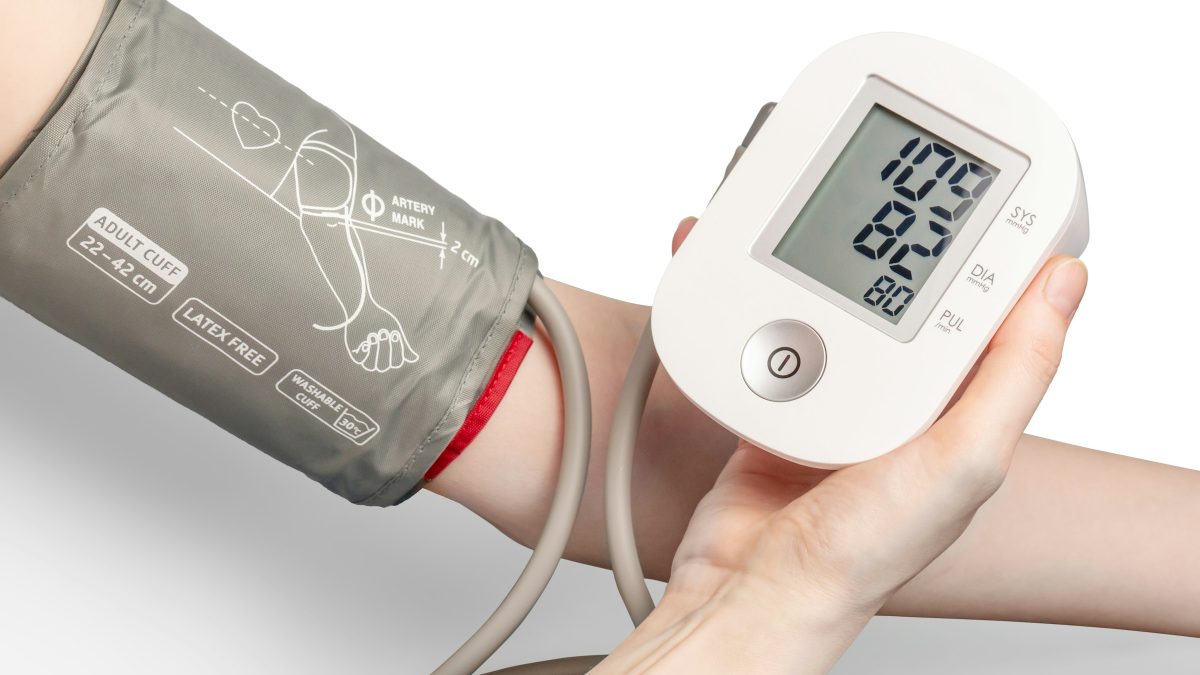
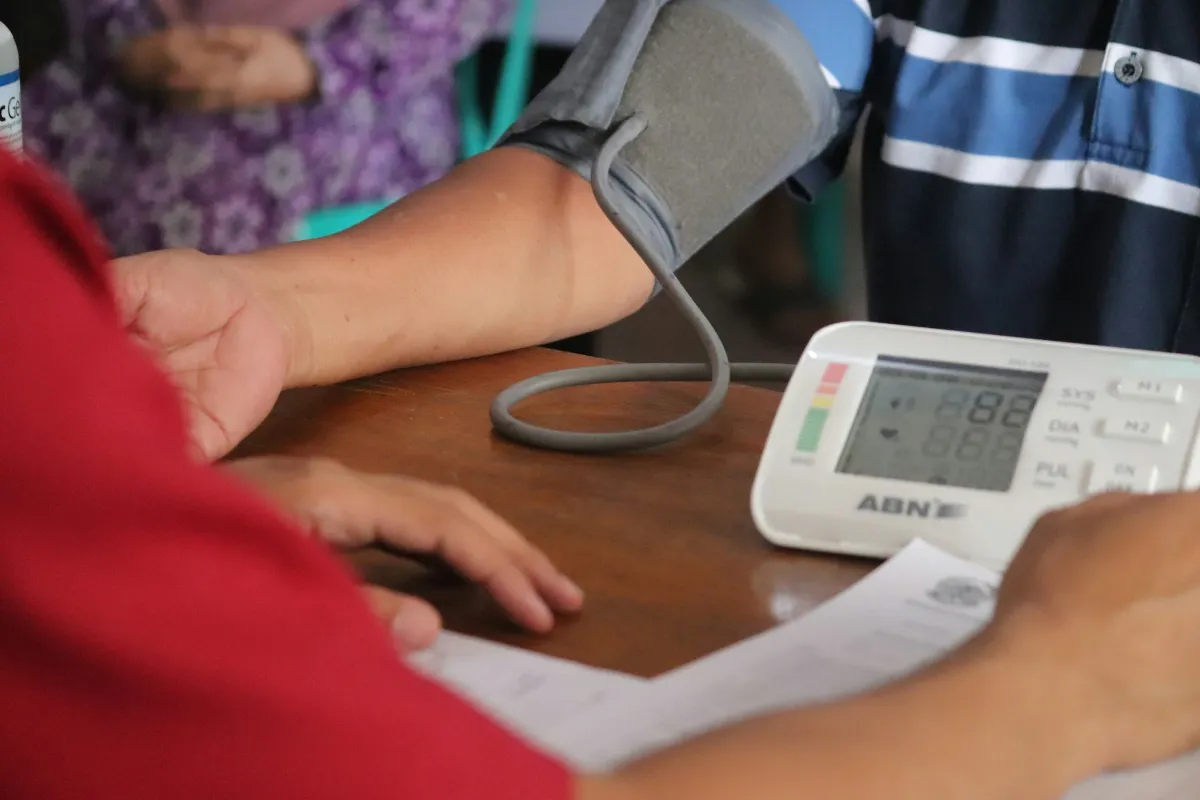
Sit with your back supported and both feet flat, rest your arm on a table with the cuff at heart height, and use a cuff that fits your arm. Small slips each add points to the reading.107 In a 2024 trial of 133 adults, a hand resting in the lap raised the top number by 3.9 points and an arm hanging at the side by 6.5, compared with an arm on a desk.8
The cuff’s size matters even more. In a 2023 trial of 195 adults, a regular cuff read the top number 19.5 points too high on arms that needed an extra-large cuff, 4.8 too high on arms that needed a large one, and 3.6 too low on arms that needed a small one.9 The range a cuff fits is usually printed on it.
Perching on an exam table, with feet dangling and the back unsupported, read 7.0/4.5 higher than a supported chair in a 2023 study, which was funded by a maker of exam chairs.10 The NHS suggests taking a reading, waiting one minute and taking another, usually twice a day, in the morning and the evening, for as many days as your doctor or nurse asks. At home, 135/85 or more counts as high.7
Why does your blood pressure number matter?
Because so much follows from it. More than 115 million adults in the US have high blood pressure, which raises the risk of heart attack, stroke, heart failure, kidney disease and narrowed arteries in the legs.1 The 2025 guideline’s chair said that lowering blood pressure also cuts the risk of dementia, by 12% to 19%.1
Worldwide, 1.4 billion adults aged 30 to 79 had high blood pressure in 2024, a third of that age group, and about 320 million had it under control.4 Doctors read your blood pressure beside your cholesterol to judge your heart risk; here is what your cholesterol numbers mean.
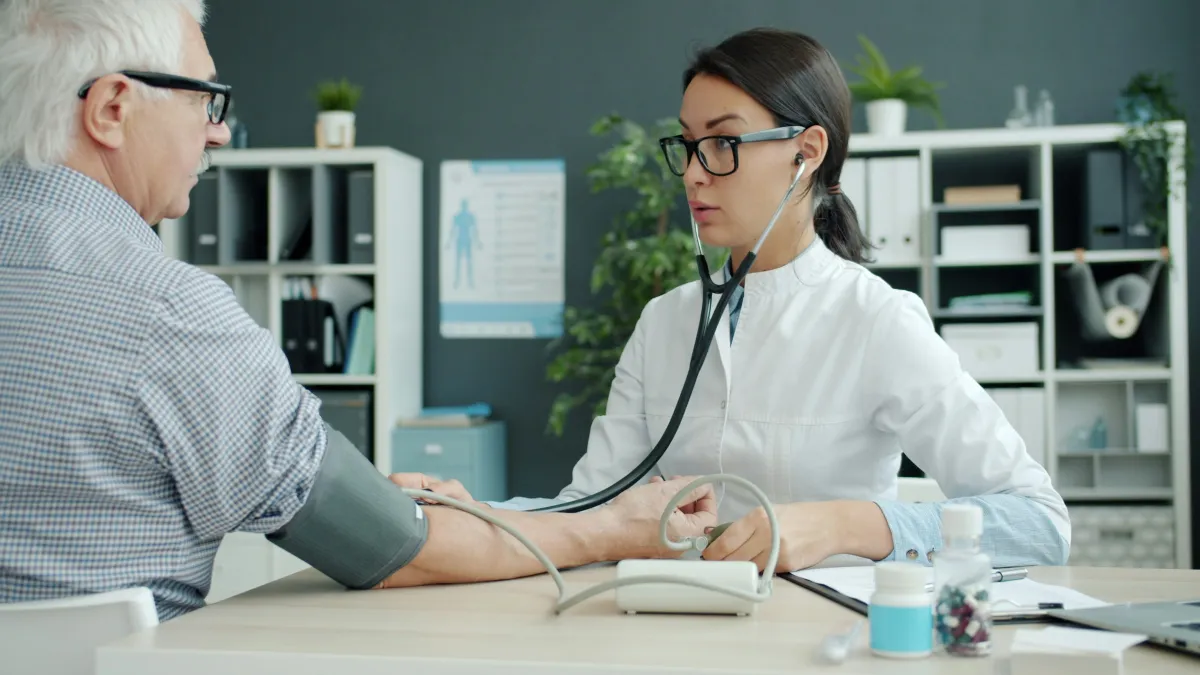
The NHS suggests a check at a pharmacy or GP surgery if you are 40 or over and have not had one for more than five years.6 It takes a few minutes, and one number written down today is the start of a trend you can follow.
Before your next blood pressure reading
- Sit with your back supported and both feet flat on the floor
- Rest your arm on a table, with the cuff at heart height
- Use a cuff that fits your upper arm, checking the range printed on it
- Take two readings a minute apart, in the morning and the evening
- Write down each number with the date, so you can see the trend
- Get checked at a pharmacy or GP if you are 40 or over and it has been five years
Sources
- American Medical Association. New BP guideline: 5 things physicians should know. 11 September 2025. ama-assn.org/public-health/prevention-wellness/new-bp-guideline-5-things-physicians-should-knowChecked 19 November 2026Back to the text
- Jones DW, Ferdinand KC, Taler SJ, et al. 2025 AHA/ACC/AANP/AAPA/ABC/ACCP/ACPM/AGS/AMA/ASPC/NMA/PCNA/SGIM guideline for the prevention, detection, evaluation and management of high blood pressure in adults. Hypertension. 2025;82(10):e212-e316. pubmed.ncbi.nlm.nih.gov/40811516/Checked 19 November 2026Back to the text
- European Society of Cardiology. New ESC Hypertension Guidelines recommend intensified BP targets and introduce a novel elevated blood pressure category to better identify people at risk for heart attack and stroke. Press release, 30 August 2024. eurekalert.org/news-releases/1056098Checked 19 November 2026Back to the text
- World Health Organization. Hypertension. Fact sheet, 25 September 2025. who.int/news-room/fact-sheets/detail/hypertensionChecked 19 November 2026Back to the text
- Fryar CD, Kit B, Carroll MD, Afful J. Hypertension prevalence, awareness, treatment, and control among adults age 18 and older: United States, August 2021 to August 2023. NCHS Data Brief No. 511. 2024. pubmed.ncbi.nlm.nih.gov/40085792/Checked 19 November 2026Back to the text
- NHS. High blood pressure (hypertension). Page last reviewed 19 July 2024. nhs.uk/conditions/high-blood-pressure/Checked 19 November 2026Back to the text
- NHS. Blood pressure test. Page last reviewed 25 November 2025. nhs.uk/tests-and-treatments/blood-pressure-test/Checked 19 November 2026Back to the text
- Liu H, Zhao D, Sabit A, et al. Arm position and blood pressure readings: the ARMS crossover randomized clinical trial. JAMA Internal Medicine. 2024;184(12):1436-1442. pubmed.ncbi.nlm.nih.gov/39373998/Checked 19 November 2026Back to the text
- Ishigami J, Charleston J, Miller ER 3rd, et al. Effects of cuff size on the accuracy of blood pressure readings: the Cuff(SZ) randomized crossover trial. JAMA Internal Medicine. 2023;183(10):1061-1068. pubmed.ncbi.nlm.nih.gov/37548984/Checked 19 November 2026Back to the text
- Alpert BS, Schwartz JE, Shapiro M, Wexler RK. Comparison of outcomes for routine versus American Heart Association-recommended technique for blood pressure measurement (CORRECT BP): a randomised cohort study. EClinicalMedicine. 2023;64:102219. pubmed.ncbi.nlm.nih.gov/37745022/Checked 19 November 2026Back to the text
Photos: Mockup Graphics, Mufid Majnun, Vitaly Gariev / Unsplash
This article is general information, not medical advice. For a question about your own health, your doctor or pharmacist is the right person to ask.